Interview with Stéphane Landry (P-Ingénierie)
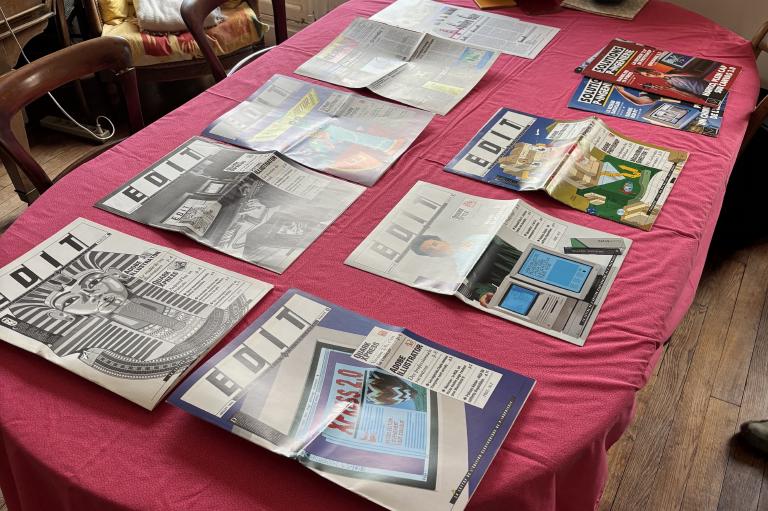
Various issues of EDIT
On February 23, 2026, Clémence Imbert conducted an interview with Stéphane Landry. From 1985 to 1997, Stéphane Landry was the director of P-Ingénierie, the company that distributed Adobe Illustrator and QuarkXPress software in France. His testimony sheds light on the key role of resellers and the marketing tools available to them.
After studying statistical engineering and gaining initial experience in developing management software for the Apple II, Stéphane Landry took part, in 1984, in the early days of Polygone Informatique. This company, founded by Jean Horn, played a central role in the spread of desktop publishing (DTP) in France through its activities in sales and consulting for companies in the graphic arts sector.
In 1985, Stéphane Landry founded his own company, P-Ingénierie, which developed and distributed in France hardware products favored by the first professional DTP users, notably Radius monitors, Abaton scanners, and MultiTalk boxes (developed by P-Ingénierie, these devices enabled a Macintosh to connect to networked peripherals—scanners and printers).
In 1987, through its American contacts, P-Ingénierie became the distributor of QuarkXPress and Adobe Illustrator. These two software programs were used in the creation of the newspaper EDIT (first issue in October 1987), produced with François Blanc (Créapress). This was a first, demonstrating that it was possible to produce a complete newspaper using DTP, with refined typography and sophisticated graphics.
Stéphane Landry’s testimony helps place these different software tools within their technological and marketing context, and provides a clearer understanding of the Franco-American networks that enabled their rapid dissemination in France. He also emphasizes the decisive role of the press: according to him, journalists—highly receptive to innovations that directly concerned them—were particularly inclined to report on these solutions and to test them in real conditions, which constituted the best possible form of publicity.