Interviews with Philippe Gerbaud and Christophe Jacquet known as Toffe — Paris / Octon, Nov. 2024—Nov 2025
en
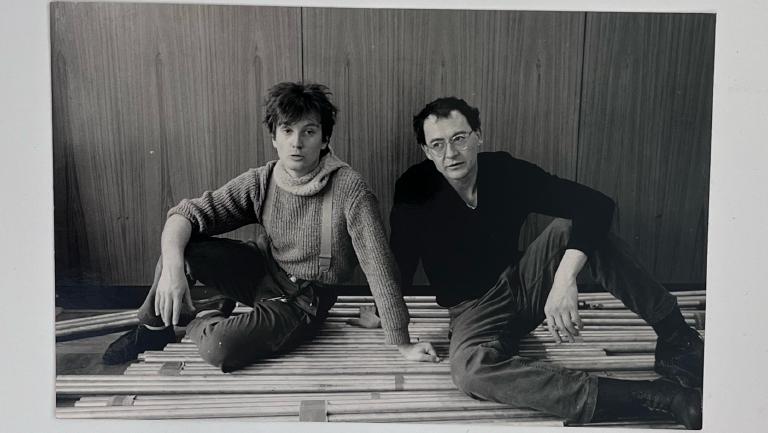
Between November 2024 and November 2025, Léonore Conte and Caroll Maréchal conducted several interviews with Christophe Jacquet, known as Toffe, and Philippe Gerbaud in their respective studios.
—
Philippe Gerbaud (1955–) and Christophe Jacquet, known as Toffe (1955–), began collaborating in the late 1970s during their studies at the École nationale supérieure des Beaux-arts in Paris. Their partnership took full shape in 1983, when they came into contact with Jacques-François Marchandise—writer, and today a researcher and professor of futures studies at Université Gustave-Eiffel in Marne-la-Vallée (Seine-et-Marne), specializing in the social and environmental implications of digital technologies)—and subsequently with Marylène Delbourg-Delphis, director of the Studio A.C.I. (Analyses, Conseils, Informations), which at the time was working with Apple on software publishing. The Apple Lisa computer (Local Integrated Software Architecture) was provided to them in exchange for experimental work intended to demonstrate the creative potential of software then in development. Their first digital drawings were exhibited in the fall of 1983 as part of Electra at the Musée d’Art moderne de la Ville de Paris. Shortly thereafter, they met Jean-Louis Gassée, Apple’s representative in France, who lent them—prior to its official release in France in January 1984—the first American Macintosh 128K personal computer, equipped with a floppy disk drive, a mouse, and a printer (ImageWriter). Working together, they shared the digital tool, merging their respective visual worlds—shaped, respectively, by fine art and by comics—and tested the physical and technical limits of early WYSIWYG tools such as MacPaint and MacWrite through projects at various scales: drawings, textile patterns, posters, installations, and more.
Taken as a whole, their early explorations with the computer—conducted individually and collaboratively, and later described by Pierre Milville as “pre-Magdalenian fragments”—bear witness to the wealth of transformations perceived within the fields of art and graphic design with the advent of the computer. Following these experiments, while Philippe Gerbaud went on to develop an extensive illustration practice, Toffe opened himself to graphic design commissions, which he has continued to integrate into his artistic practice.